🇪🇸 Un paseo personal por la ciudad más antigua de Estados Unidos
Mi paseo por San Agustín fue una experiencia cautivadora: cada calle, rincón y edificio me transportaba más a un pueblo español que a una ciudad estadounidense. Fundada el 8 de septiembre de 1565 por Pedro Menéndez de Avilés, San Agustín es el asentamiento europeo en continuo funcionamiento más antiguo del país.
El centro histórico es un lugar para recorrer sin prisa. Sus calles adoquinadas, estrechas y llenas de balcones floridos invitan a perderse. Las fachadas, muchas en tonos cálidos y con patios interiores, conservan ese aire colonial español que lo hace único. Caminando, me sorprendía descubrir pequeñas tiendas de artesanías, galerías de arte y cafés con encanto, cada uno con su propio carácter. Por la noche, el ambiente se transforma: la influencia latina se siente en los bares con música en vivo, restaurantes abiertos hasta tarde y un ir y venir de gente que mantiene la zona llena de vida.
La joya indiscutible es el Castillo de San Marcos, el fuerte más antiguo de mampostería en los Estados Unidos. Construido entre 1672 y 1695 con una piedra local llamada coquina, resistió numerosos asedios coloniales. Lo visité por dentro: las murallas, las casamatas, las exhibiciones y los guías vestidos de época hacen que el pasado cobre vida. El fuerte abre todos los días de 9:00 a.m. a 5:15 p.m., y los alrededores permanecen accesibles desde la madrugada hasta la medianoche.
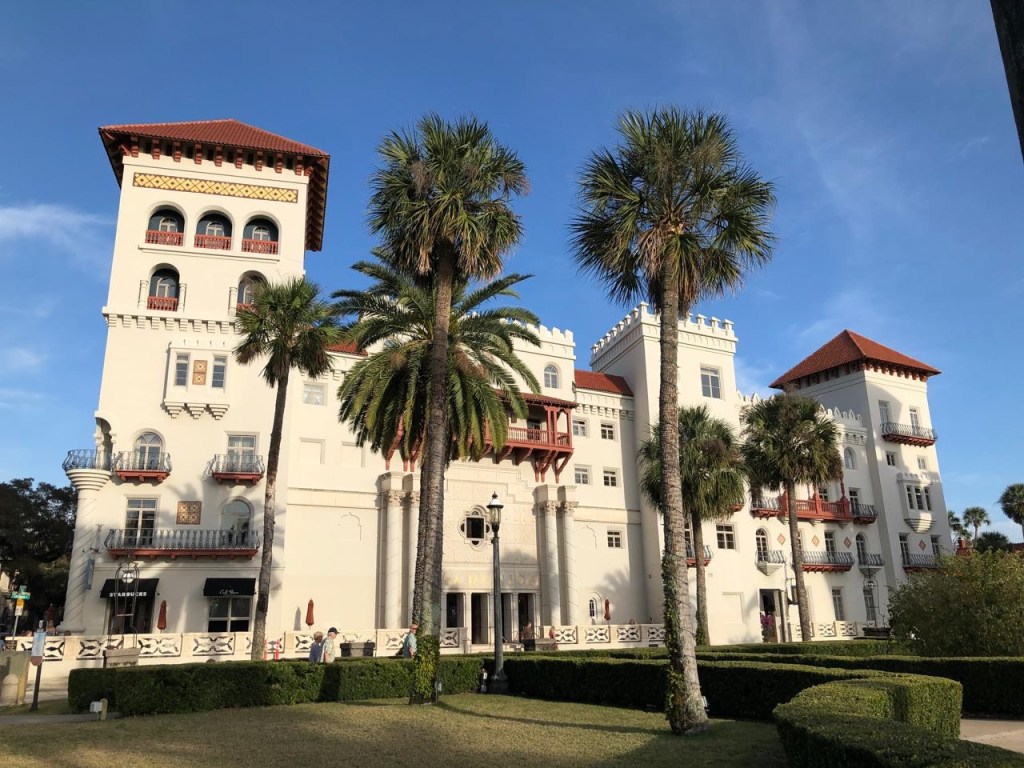
Otra parada inolvidable es Casa Mónica, un hotel boutique con una arquitectura de estilo español-renacentista espectacular, justo en el corazón del casco histórico. Es majestuoso por fuera y refinado por dentro; alojarse allí o simplemente visitarlo es como entrar en un capítulo de otra época.
No muy lejos se encuentra Flagler College, una universidad impresionante tanto en fachada como en diseño interior. Ofrece carreras en áreas como administración, arte, ciencias sociales, comunicación, educación y ciencias naturales. Recorrer sus jardines con fuentes y su arquitectura neogótica es realmente inspirador.
San Agustín también tiene playas que se diferencian del típico litoral de Florida: St. Augustine Beach y Crescent Beach, con dunas y un ambiente más pausado y europeo.
En cuanto a gastronomía, probé dos lugares que me encantaron: Meehan’s, un restaurante frente al agua con platos locales, y Aunt Kate’s, ideal para desayunos tradicionales. Para un capricho dulce, me dejé tentar en Hyppo y con los chocolates de Whetstone Chocolates.
Entre los barrios residenciales que recorrí, destacaría Lincolnville, con su historia y carácter únicos, y Anastasia Island, más tranquilo y costero, con casas acogedoras y ambiente relajado.
Para llegar, San Agustín está bien conectada por carretera: Jacksonville queda a solo unos 50 minutos en auto; Orlando está a unos 170 km; Miami, bastante más al sur, a unos 650 km; y Tallahassee, la capital del estado, a unos 330 km. Además, está muy cerca del límite con Georgia, lo que refuerza ese aire cultural y arquitectónico tan diferente al resto de Florida.
————————————————————
🇬🇧 A personal stroll through the oldest city in the United States
My visit to St. Augustine was a captivating experience: every street, corner, and building made me feel like I was in a Spanish town rather than in the United States. Founded on September 8, 1565 by Pedro Menéndez de Avilés, St. Augustine is the oldest continuously inhabited European settlement in the country.
The historic center is a place to wander without rushing. Its narrow cobblestone streets, lined with flower-filled balconies, invite you to get lost. Many façades in warm tones, with inner courtyards, keep that unique Spanish colonial character. As I walked, I kept discovering small craft shops, art galleries, and charming cafés, each with its own personality. At night, the atmosphere changes completely: the Latin influence comes alive in bars with live music, restaurants open until late, and a lively flow of people enjoying the evening.
The undeniable highlight is the Castillo de San Marcos, the oldest masonry fort in the United States. Built between 1672 and 1695 with a local stone called coquina, it withstood numerous colonial sieges. Visiting inside, I saw the walls, casemates, exhibitions, and costumed guides that bring history to life. The fort is open daily from 9:00 a.m. to 5:15 p.m., and the grounds are accessible from early morning until midnight.
Another unforgettable stop is Casa Monica, a boutique hotel with spectacular Spanish Renaissance-style architecture, right in the heart of the historic district. Majestic on the outside and refined on the inside, staying there—or simply visiting—feels like stepping into another era.
Not far away stands Flagler College, a university impressive both inside and out. It offers programs in business, art, social sciences, communication, education, and natural sciences. Walking through its gardens with fountains and admiring its neo-Gothic architecture was truly inspiring.
St. Augustine also has beaches that differ from Florida’s typical coastline: St. Augustine Beach and Crescent Beach, with dunes and a calmer, more European atmosphere.
As for food, I enjoyed two places in particular: Meehan’s, a waterfront restaurant serving local dishes, and Aunt Kate’s, perfect for a traditional breakfast. For something sweet, I couldn’t resist Hyppo’s artisan popsicles or the handcrafted chocolates from Whetstone Chocolates.
Among the residential neighborhoods I explored, I’d highlight Lincolnville, with its unique history and character, and Anastasia Island, a quieter, coastal area with cozy homes and a relaxed vibe.
Getting there is easy by car: Jacksonville is only about 50 minutes away; Orlando is around 170 km; Miami is much farther south, about 650 km; and Tallahassee, the state capital, is about 330 km away. St. Augustine is also very close to the Georgia border, adding to its unique cultural and architectural charm.
⸻————————————————————
🇩🇪 Ein persönlicher Spaziergang durch die älteste Stadt der USA
Mein Besuch in St. Augustine war eine faszinierende Erfahrung: Jede Straße, jede Ecke und jedes Gebäude ließ mich eher an ein spanisches Städtchen als an eine Stadt in den USA denken. Gegründet am 8. September 1565 von Pedro Menéndez de Avilés, ist St. Augustine die älteste durchgehend bewohnte europäische Siedlung des Landes.
Das historische Zentrum lädt dazu ein, ohne Eile umherzuschlendern. Die schmalen Kopfsteinpflasterstraßen mit ihren blumengeschmückten Balkonen laden zum Verlaufen ein. Viele Fassaden in warmen Farbtönen mit Innenhöfen bewahren den einzigartigen spanisch-kolonialen Charakter. Beim Spazieren entdeckte ich immer wieder kleine Kunsthandwerksläden, Galerien und charmante Cafés, jedes mit seinem eigenen Stil. Abends verändert sich die Atmosphäre: Der lateinamerikanische Einfluss zeigt sich in Bars mit Live-Musik, Restaurants, die bis spät geöffnet sind, und einem regen Treiben bis in die Nacht.
Das unbestrittene Highlight ist das Castillo de San Marcos, das älteste Mauerwerk-Fort der Vereinigten Staaten. Zwischen 1672 und 1695 aus einem örtlichen Stein namens Coquina erbaut, widerstand es zahlreichen kolonialen Belagerungen. Beim Besuch im Inneren sah ich die dicken Mauern, Kasematten, Ausstellungen und kostümierte Führer, die Geschichte lebendig werden lassen. Das Fort ist täglich von 9:00 bis 17:15 Uhr geöffnet, und das Gelände ist vom frühen Morgen bis Mitternacht zugänglich.
Ein weiterer unvergesslicher Stopp ist das Casa Monica, ein Boutique-Hotel mit spektakulärer Architektur im spanischen Renaissancestil, mitten im Herzen der Altstadt. Majestätisch von außen und edel von innen – ein Aufenthalt oder auch nur ein Besuch fühlt sich wie eine Zeitreise an.
Nicht weit entfernt steht das Flagler College, eine Universität, die sowohl innen als auch außen beeindruckt. Sie bietet Studiengänge in Betriebswirtschaft, Kunst, Sozialwissenschaften, Kommunikation, Pädagogik und Naturwissenschaften an. Durch die Gärten mit Brunnen zu spazieren und die neugotische Architektur zu bewundern, war für mich wirklich inspirierend.
St. Augustine hat auch Strände, die sich vom typischen Florida-Küstenbild unterscheiden: St. Augustine Beach und Crescent Beach mit Dünen und einer ruhigeren, fast europäischen Atmosphäre.
Kulinarisch gefielen mir besonders zwei Orte: Meehan’s, ein Restaurant am Wasser mit regionalen Spezialitäten, und Aunt Kate’s, perfekt für ein traditionelles Frühstück. Für etwas Süßes konnte ich den handgemachten Eis am Stiel von Hyppo oder den Pralinen von Whetstone Chocolates nicht widerstehen.
Von den Wohnvierteln, die ich erkundet habe, möchte ich Lincolnville hervorheben, mit seiner besonderen Geschichte und seinem Charakter, sowie Anastasia Island, ein ruhigeres Küstenviertel mit gemütlichen Häusern und entspannter Atmosphäre.
Die Anreise ist einfach mit dem Auto: Jacksonville ist nur etwa 50 Minuten entfernt, Orlando rund 170 km, Miami weiter südlich etwa 650 km und Tallahassee, die Hauptstadt des Bundesstaates, rund 330 km. St. Augustine liegt außerdem ganz in der Nähe der Grenze zu Georgia, was seinen kulturellen und architektonischen Charme noch verstärkt.
 Travelling Pic Travel Blog
Deja un comentario