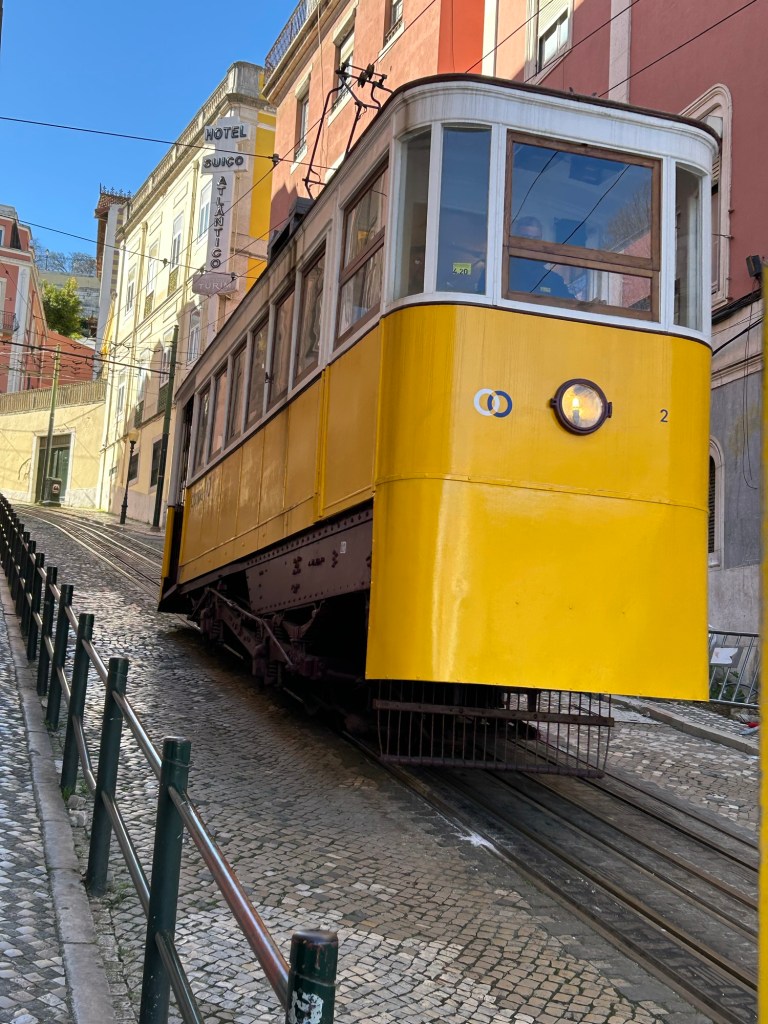
🇪🇸 Lisboa me maravilló. Esta ciudad ofrece una mezcla única de historia, cultura, modernidad y belleza natural que hace que cada rincón sea fascinante. Desde sus tranvías antiguos, algunos de ellos turísticos como el 28 o el 12, hasta otros que forman parte del sistema público, Lisboa tiene un encanto incomparable.
Uno de los puntos más emblemáticos es el Monumento a los Descubrimientos, situado cerca del río, en la zona de Belém. Esta imponente estructura celebra a los navegantes portugueses que marcaron la historia de los descubrimientos en el siglo XV. Cerca de este monumento se encuentra la famosa Torre de Belém, un antiguo fuerte que, como guardián del río, protegía la entrada al puerto de Lisboa. Justo en el mismo barrio, el Monasterio de los Jerónimos es donde, según algunos, se originaron los famosos pasteles de Belém, ¡un deleite que no puedes dejar de probar!
Lisboa es una ciudad a la que se puede llegar fácilmente en avión, en auto —como hice yo desde España— o en tren. Una vez allí, moverse por la ciudad es muy sencillo. Hay una gran red de transporte público, con metro, tranvías, ómnibus modernos, e incluso trenes regionales. Pero también es una ciudad que se puede recorrer perfectamente a pie. Yo usé el metro para llegar a un punto, luego tomé un solo tranvía para subir a la parte alta, caminé toda la ciudad y al final del día, cuando ya estaba cansada, tomé el tranvía para bajar. A pesar de las calles empedradas, Lisboa es una ciudad caminable, y eso hace que uno la viva con todos los sentidos.
Además de los tranvías, Lisboa cuenta con varios ascensores históricos que conectan la parte baja con la alta. El más famoso es el Elevador de Santa Justa, una estructura de hierro que ofrece vistas panorámicas espectaculares. También están el Elevador da Bica, que sube por un pintoresco callejón empedrado; el Elevador da Glória, que lleva hasta el mirador de São Pedro de Alcântara; y el Elevador do Lavra, el más antiguo de todos. Son parte del sistema de transporte público y también una experiencia única.
En la parte alta se encuentra el Castillo de San Jorge, desde donde se pueden admirar las mejores vistas de Lisboa. En sus alrededores, las calles empedradas del barrio de Alfama conservan ese aire antiguo, con casas coloridas, ropa tendida en los balcones, y tienditas donde se venden preciosos cuadritos de cerámica pintada a mano. En Lisboa, hasta los nombres de las calles están hechos de azulejos.
En la parte baja, la ciudad impresiona por su grandiosidad: avenidas amplias, estatuas imponentes, y veredas de piedra blanca y negra con diseños geométricos que recuerdan mucho al paseo de Copacabana, en Río de Janeiro. Uno de los lugares más impresionantes es la Praça do Comércio, una enorme plaza abierta al río Tajo, rodeada de majestuosos edificios amarillos y un imponente arco de triunfo. Allí mismo hay una pequeña playa urbana y un muelle donde uno puede sentarse a ver el atardecer.
Lisboa también tiene muchos miradores (miradouros) repartidos por toda la ciudad: el de Santa Lucía, el de Senhora do Monte o el de Graça ofrecen vistas inolvidables. Y si hablamos de ambiente, no se puede dejar de mencionar el alma musical de Lisboa: el Fado, que se puede escuchar especialmente en barrios como Alfama o Bairro Alto, en pequeños bares donde también se puede cenar.
La oferta gastronómica es increíble. Desde los tradicionales restaurantes con música en vivo, hasta opciones vegetarianas, veganas o internacionales, como restaurantes mexicanos. Además, los cafés son parte importante de la cultura lisboeta. Desde principios del siglo XIX, el café se hizo parte del día a día, y algunos de los más emblemáticos son el Café A Brasileira, la Pastelaria Versailles y el Martinho da Arcada.
Y por supuesto, no se puede ir uno de Lisboa sin probar los famosos pastéis de Belém, con su hojaldre crujiente y crema suave, vendidos desde 1837 en la pastelería del barrio del mismo nombre.
Uno de los lugares que más me llamó la atención fue Pink Street, una calle que antiguamente albergaba locales nocturnos y bares tradicionales, y que hoy se ha reinventado como un punto de encuentro moderno, colorido y cultural, lleno de bares con encanto y arte urbano.
Lisboa también es un excelente punto de partida para explorar los alrededores. A muy pocos kilómetros está Sintra, con su Palacio da Pena, un castillo de cuento rodeado de vegetación. Y también Cascais, un encantador destino de playa al que se puede llegar en tren o en auto por autopista.
Lisboa no es solo una ciudad para ver, es una ciudad para sentir, caminar y vivir. Y te deja con unas ganas inmensas de volver.
—————————————————————
🇬🇧 Lisbon amazed me. This city offers a unique mix of history, culture, modernity, and natural beauty that makes every corner fascinating. From its old trams — some of them tourist attractions like number 28 or 12 — to others that are part of the public transport system, Lisbon has an incomparable charm.
One of the most iconic landmarks is the Monument to the Discoveries, located near the river in the Belém area. This impressive structure celebrates the Portuguese navigators who shaped the Age of Discoveries in the 15th century. Nearby stands the famous Belém Tower, an old fortress that once protected the entrance to Lisbon’s port. In the same neighborhood, the Jerónimos Monastery is said by some to be where the famous Pastéis de Belém originated — a treat you simply must try!
Lisbon is easy to reach by plane, car — as I did from Spain — or train. Once there, getting around the city is very simple. There’s an extensive public transport network, including metro, trams, modern buses, and even regional trains. But it’s also a city that can be explored perfectly on foot. I used the metro to get to one place, then took a single tram to go up to the upper part, walked all over the city, and at the end of the day, when I was tired, I took the tram to go back down. Despite the cobbled streets, Lisbon is a walkable city, and that makes you experience it with all your senses.
In addition to the trams, Lisbon has several historic elevators connecting the lower and upper parts of the city. The most famous is the Elevador de Santa Justa, an iron structure offering spectacular panoramic views. There’s also the Elevador da Bica, which climbs a picturesque cobbled alley; the Elevador da Glória, which goes up to the São Pedro de Alcântara viewpoint; and the Elevador do Lavra, the oldest of them all. They’re part of the public transport system and a unique experience too.
In the upper part, you’ll find São Jorge Castle, which offers the best views of Lisbon. Around it, the cobbled streets of the Alfama district still preserve an old-time feel, with colorful houses, laundry hanging on the balconies, and little shops selling beautiful hand-painted ceramic tiles. In Lisbon, even the street names are made of azulejos.
In the lower part, the city impresses with its grandeur: wide avenues, majestic statues, and black-and-white stone sidewalks with geometric patterns reminiscent of the Copacabana promenade in Rio de Janeiro. One of the most striking places is Praça do Comércio, a huge square open to the Tagus River, surrounded by majestic yellow buildings and an imposing triumphal arch. Right there, there’s a small urban beach and a pier where you can sit and watch the sunset.
Lisbon also has many viewpoints (miradouros) scattered throughout the city: Santa Luzia, Senhora do Monte, and Graça offer unforgettable views. And when it comes to atmosphere, you can’t forget Lisbon’s musical soul — Fado — which can be heard especially in neighborhoods like Alfama or Bairro Alto, in small bars where you can also have dinner.
The food scene is amazing. From traditional restaurants with live music to vegetarian, vegan or international options, like Mexican places. Also, cafés are an important part of Lisbon’s culture. Since the early 19th century, coffee has been part of everyday life, and some of the most iconic cafés include A Brasileira, Pastelaria Versailles and Martinho da Arcada.
And of course, you can’t leave Lisbon without trying the famous pastéis de Belém, with their crispy pastry and smooth custard cream, sold since 1837 in the bakery of the same name.
One of the places that caught my attention the most was Pink Street, a street that once housed traditional bars and night venues, and has now reinvented itself as a modern, colorful, and cultural meeting point, full of charming bars and street art.
Lisbon is also a great base to explore the surroundings. Just a few kilometers away is Sintra, with its Palácio da Pena — a fairytale-like castle surrounded by lush greenery. There’s also Cascais, a charming beach destination you can reach by train or highway.
Lisbon is not just a city to see — it’s a city to feel, walk, and live. And it leaves you with an incredible desire to return.
⸻————————————
🇩🇪 Lissabon hat mich verzaubert. Diese Stadt bietet eine einzigartige Mischung aus Geschichte, Kultur, Moderne und natürlicher Schönheit – jede Ecke ist faszinierend. Von den alten Straßenbahnen, einige davon touristisch wie die Linie 28 oder 12, bis hin zu jenen, die Teil des öffentlichen Verkehrssystems sind – Lissabon hat einen unvergleichlichen Charme.
Eines der bekanntesten Wahrzeichen ist das Denkmal der Entdeckungen (Padrão dos Descobrimentos), das sich in der Nähe des Flusses im Stadtteil Belém befindet. Dieses imposante Bauwerk ehrt die portugiesischen Seefahrer, die im 15. Jahrhundert die Ära der Entdeckungen geprägt haben. Ganz in der Nähe steht der berühmte Torre de Belém, eine alte Festung, die einst den Eingang zum Hafen von Lissabon schützte. Ebenfalls im selben Viertel liegt das Hieronymitenkloster (Mosteiro dos Jerónimos), in dem – so sagt man – die berühmten Pastéis de Belém entstanden sind. Ein Genuss, den man sich nicht entgehen lassen sollte!
Lissabon ist leicht zu erreichen – mit dem Flugzeug, dem Auto (so wie ich, von Spanien aus) oder mit dem Zug. Einmal angekommen, ist das Fortbewegen in der Stadt sehr einfach. Es gibt ein gut ausgebautes öffentliches Verkehrsnetz mit U-Bahn, Straßenbahnen, modernen Bussen und sogar Regionalzügen. Aber man kann die Stadt auch wunderbar zu Fuß erkunden. Ich habe die U-Bahn genommen, um zu einem Punkt zu kommen, dann eine einzige Straßenbahn, um in den oberen Teil der Stadt zu gelangen. Ich bin den ganzen Tag gelaufen und am Ende, als ich müde war, wieder mit der Bahn hinuntergefahren. Trotz der Kopfsteinpflaster ist Lissabon gut begehbar – man erlebt die Stadt mit allen Sinnen.
Neben den Straßenbahnen gibt es in Lissabon auch mehrere historische Aufzüge, die die Unter- mit der Oberstadt verbinden. Der bekannteste ist der Elevador de Santa Justa – eine eiserne Konstruktion mit spektakulärer Aussicht. Es gibt auch den Elevador da Bica, der durch eine malerische gepflasterte Gasse führt, den Elevador da Glória, der zum Aussichtspunkt São Pedro de Alcântara fährt, und den Elevador do Lavra – der älteste von allen. Sie gehören zum öffentlichen Verkehrsnetz und bieten ein ganz besonderes Erlebnis.
Im oberen Teil der Stadt liegt das Castelo de São Jorge, von wo aus man den besten Blick auf Lissabon hat. In der Umgebung bewahren die gepflasterten Gassen des Viertels Alfama ihren historischen Charme – mit bunten Häusern, Wäscheleinen auf den Balkonen und kleinen Läden, in denen handbemalte Keramik verkauft wird. In Lissabon bestehen sogar die Straßenschilder aus Azulejos.
Die Unterstadt beeindruckt durch ihre Großzügigkeit: breite Alleen, imposante Statuen und schwarz-weiße Steinmuster auf den Gehwegen, die an die Promenade von Copacabana in Rio de Janeiro erinnern. Besonders eindrucksvoll ist der Praça do Comércio – ein riesiger Platz am Ufer des Tejo, umgeben von prächtigen gelben Gebäuden und einem imposanten Triumphbogen. Direkt daneben gibt es einen kleinen Stadtstrand und einen Steg, auf dem man den Sonnenuntergang genießen kann.
In der ganzen Stadt sind Aussichtspunkte (Miradouros) verteilt: Santa Luzia, Senhora do Monte oder Graça bieten unvergessliche Ausblicke. Und wenn es um Stimmung geht, darf man das musikalische Herz Lissabons nicht vergessen: den Fado – den man besonders in den Vierteln Alfama oder Bairro Alto hören kann, in kleinen Bars, in denen man auch essen kann.
Auch kulinarisch hat die Stadt viel zu bieten – von traditionellen Restaurants mit Live-Musik über vegetarische und vegane Optionen bis hin zu internationalen Lokalen wie mexikanischen Restaurants. Cafés sind ein wichtiger Teil der lokalen Kultur. Seit dem frühen 19. Jahrhundert ist Kaffee Teil des Alltags. Zu den bekanntesten Cafés gehören A Brasileira, Pastelaria Versailles und Martinho da Arcada.
Und natürlich darf man Lissabon nicht verlassen, ohne die berühmten Pastéis de Belém zu probieren – mit ihrem knusprigen Blätterteig und der zarten Vanillecreme, die seit 1837 in der gleichnamigen Bäckerei im Stadtteil Belém verkauft werden.
Eine Straße, die mich besonders beeindruckt hat, war Pink Street – eine Straße, die früher traditionelle Bars und Nachtlokale beherbergte und sich heute in einen modernen, farbenfrohen und kulturellen Treffpunkt verwandelt hat, voller gemütlicher Bars und Street Art.
Lissabon ist auch ein idealer Ausgangspunkt für Ausflüge in die Umgebung. Nur wenige Kilometer entfernt liegt Sintra mit dem märchenhaften Palácio da Pena, umgeben von grüner Natur. Oder Cascais – ein charmantes Strandziel, das man bequem mit dem Zug oder dem Auto über die Autobahn erreicht.
Lissabon ist nicht nur eine Stadt zum Anschauen – sie ist eine Stadt zum Spüren, Erleben und Durchstreifen. Und sie hinterlässt eine riesige Sehnsucht, zurückzukehren.
 Travelling Pic Travel Blog
Deja un comentario